Refrigerant Guidance
Helping You Adapt to New HFC Phasedown Requirements
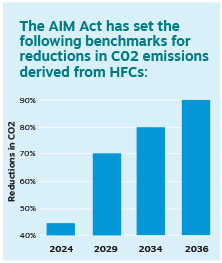
 For several years, the Environmental Protection Agency (EPA) has been phasing down the supply of hydrofluorocarbon (HFC) refrigerants to help reduce their emissions and environmental impact. The American Innovation in Manufacturing (AIM) Act limits how much HFC can be used in new equipment, reducing the available supply by 70 percent by 2029.
The team at EMCOR Mechanical Services is ready to help guide you through these regulations, understand the impact on your facility, and develop a plan for your equipment as new requirements take effect each year.
Supply Reductions and Impacts on Existing Equipment
 Existing commercial chillers, rooftop units, split units, and VRF systems will not need to be converted to operate with low-global warming potential (GWP) refrigerants. However, clients with existing equipment that uses other HFCs should prepare for decreased supply and increased costs — especially in later years of the phasedown.
We will continue to support and maintain these systems, as current regulations allow us to replace failed components. Our technicians can also help identify leaks early, to preserve supply, and will take your unique needs into account when recommending repair or replacement.
New Leak Repair Requirements
 Starting January 1, 2026, businesses that use refrigerants must comply with new operating and reporting requirements under the AIM Act. These rules now apply to a broader range of equipment, thereby impacting more businesses, including some previously exempt.
Key Impacts:
- Any HVAC or refrigeration system with 15 pounds or more of refrigerant must now be managed for leaks (previously the limit was 50 pounds or more). Light commercial air conditioners, heat pumps, and residential units are exempt.
- Annual leakage rates must be brought within less than 10 percent of total charge.
Detailed Tracking & Documentation
Businesses must maintain accurate records of refrigerant use, leaks, and repairs—and submit reports to the EPA as required.
- Records must be maintained for at least three years after the retirement of any asset with 15 or more pounds of refrigerant—regardless of refrigerant type.
- Annual leakage rate must be calculated each time refrigerant is added to an existing system. If the leakage rate exceeds 10 percent of total charge, the leak must be identified and repaired within 30 days.
- Leak repairs must be verified when a system is brought back online and re-verified within 10 days.
- Annual leak inspections are required until the system has demonstrated a leakage rate of less than 10 percent of total charge for one year.
- If leaks are not repaired within the required time frame, a retrofit or retirement plan must be developed.
We’re Here to Help
Our mechanical services team provides:
- Compliance Assessments – Identify gaps to help ensure readiness for 2026 and beyond.
- Detailed documentation – Track all refrigerant transactions via service reports. Identify any systems that are known to leak and proactively develop a plan to repair, replace, or retire the system.
- Refrigerant Management Programs – Track usage, automate reporting, and prepare for audits.
- Regulatory Guidance – Stay ahead of federal and state-specific requirements.
Whether replacing equipment, creating conversion plans, or strategizing for HFC supply restrictions, we can help you develop a proactive, customized plan. Contact us today.